 Loop
Loop Lace
Lace Materials
High-performance composites: we make the material ourselves
Towpreg is the starting material for high-performance composites. Spherecube formulates and produces its own continuous-fibre tapes (towpreg) with LOOM, its proprietary impregnation system: the fibre-to-resin ratio is controlled before deposition with LOOP. LOOM is an in-house Spherecube production system, not a product for sale: customers receive the pre-impregnated towpreg. Today we use thermoset matrices, with press cure times of 6 minutes*, while structural thermoplastics are in development. The fibre-to-resin ratio is set before deposition, so the part does not depend on how the resin is applied. Each material has its own datasheet and the figures apply only to that fibre and matrix combination.
Data sheets for high-performance composites
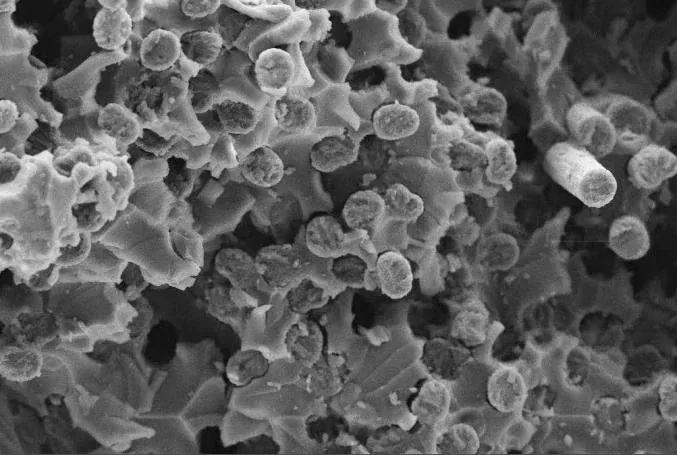
Carbon fibre is our structural reference material among high-performance composites. Its very high specific stiffness and strength suit brackets, arms, housings and parts that replace metal. Porosity is below 2%, verified by electron microscopy and the press cure takes 6 minutes*. The gain over metal is large: on one of our aerospace projects, a component redesigned in continuous carbon/epoxy came out 93% lighter, with the required performance maintained.
Values from the Spherecube technical data sheet (TDS, 2026) on UD coupons. Bars on a common scale across both materials.
Tg ≥ 400 °C · UL94 V-0 · FAR 25.853 · ASTM E595
A flame-retardant composite that is transparent to electromagnetic waves, stable at high temperature and self-extinguishing. For radomes, antenna and sensor covers and for aerospace, space and defence parts exposed to heat. The resin is rated UL94 V-0 and complies with FAR 25.853. Co-cures with epoxies and cyanate esters.
Values from the Spherecube data sheet on UD coupons.
The structural performance of carbon fibre with the same very-high-Tg flame-retardant resin used in QZ-400 FR, classified UL94 V-0. For brackets, supports and covers in aerospace, defence and transport that must be light and withstand fire and heat. Compared with CFRP on structural epoxy, the matrix changes, not the fibre: stiffness and strength remain those of carbon.
Values under qualification on UD coupons.
Quartz fibre with the structural epoxy of our CFRP. Quartz stays transparent to electromagnetic waves and has a low dielectric constant, so it suits radomes, antenna and sensor covers where the fire resistance of QZ-400 FR is not needed. With epoxy the press cure takes 6 minutes*, for faster cycles and lower cost.
Values under qualification on UD coupons.
The next step is unidirectional tape with structural thermoplastic matrices, now in development. Compared with thermoset matrices, consolidation happens by melting, with no cure cycle: the parts are tough, weldable and recyclable and they keep the same path freedom that LOOP gives today.
Materials in development: values will be published after coupon qualification.
* Cure time depends on the mass to be cured and on the resin type. Measured on a sports-sector component with epoxy resin.
Where the material is born: from dry spool to towpreg
LOOM is the machine we use to impregnate the fibre. It takes dry continuous fibre and impregnates it with resin at the right ratio, the same amount in every metre of tow. The towpreg reaches LOOP ready to use, with no manual resin application, very few voids and no variation. Automated manufacturing of high-performance composites therefore starts from a consistent material.

Always the same amount of resin
We set the fibre-to-resin ratio in LOOM, before the tow reaches LOOP. Stiffness, strength and porosity stay predictable, part after part. With hand lay-up, by contrast, resin content and compaction change from one part to the next; here the same amount of resin runs along every metre of tow.

Custom materials
If your specification calls for a particular resin or reinforcement, we start from it: we prepare the composite to match with LOOM, as long as the resin fits the process viscosity window. We qualify the material on coupons before moving to the part.

Less material, less impact
Fibre only where needed, no ply offcuts, fewer solvents, bio-based resins and natural fibres such as flax and hemp. According to the LCA carried out with Università Politecnica delle Marche and published in a peer-reviewed journal, our process achieves −80% CO₂ compared with traditional manufacturing. Source: Procedia CIRP, 2024 · DOI 10.1016/j.procir.2024.01.143
The full data sheet, in your inbox.
Mechanical, thermal and process properties, with test methods. Choose the material: the sheet is sent automatically.