 Lace
Lace Materials
Automated composite manufacturing, up to six axes
LOOP is an automated composite manufacturing machine. It is an additive manufacturing system that brings automated fibre deposition down to the scale of a single part: it steers the tow without wrinkles, interrupts it only where needed and works on a tilting table or a rotary mandrel. That makes it the evolution of automated fibre placement (AFP), reaching the curved, closed or mid-sized parts that conventional systems cannot lay up.
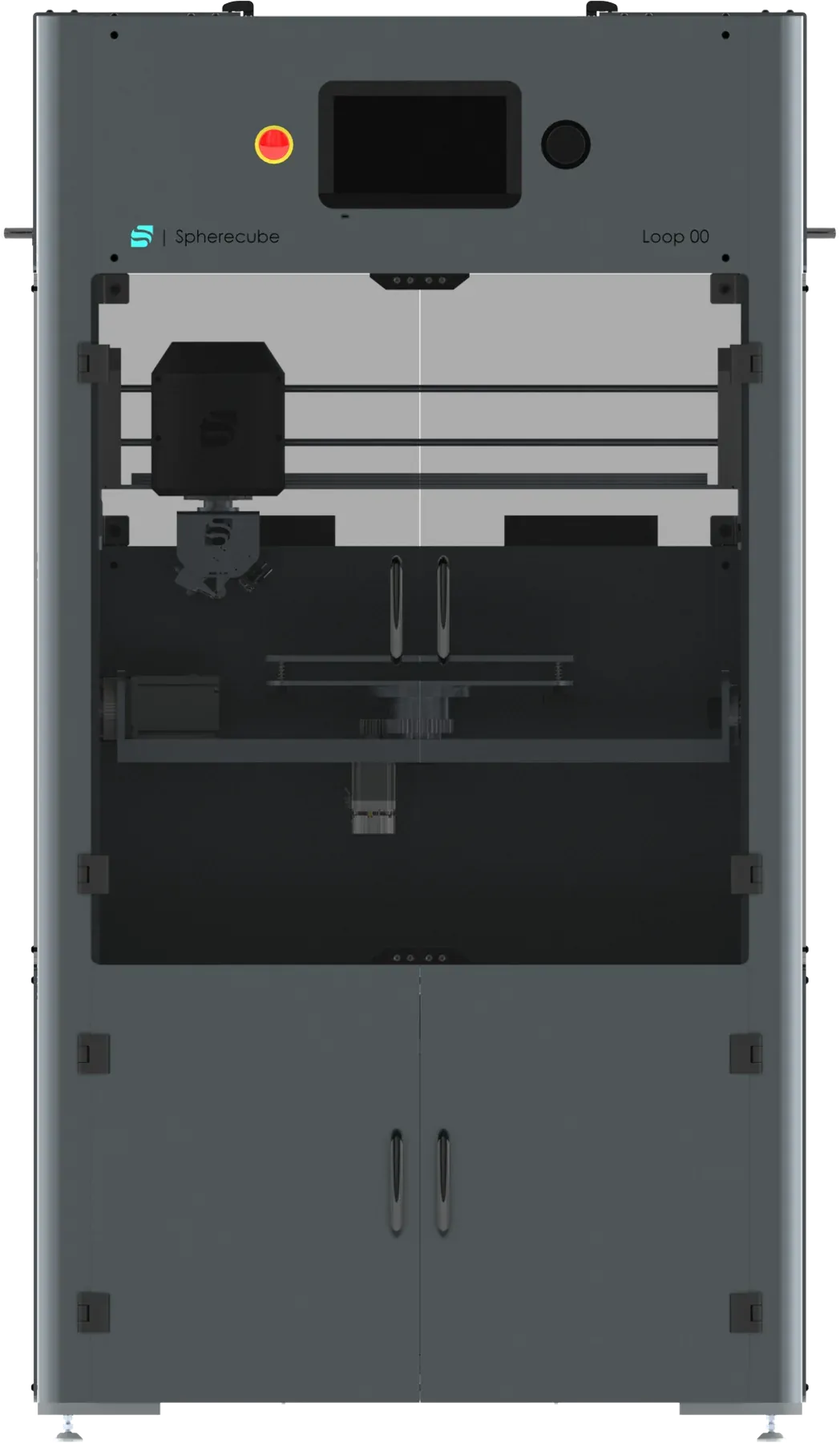
LOOP is an additive manufacturing system for structural parts in continuous-fibre composites, developed and patented by Spherecube. It lays a pre-impregnated tow prepared on our own LOOM machine, with carbon, glass, quartz, aramid, flax or hemp reinforcement and a thermoset matrix (thermoplastics are in development). The multi-axis head orients it in any direction and steers it without changing its width or thickness. The part is built on a mould, tool or rotary mandrel and then cured off the machine in a press, autoclave or oven under pressure.
3K UD continuous carbon / structural epoxy · Spherecube data sheet
Six axes, two configurations
Three translations and three rotations, distributed differently depending on the part. Pick the configuration at the top right and hover the axes to see them in the drawing.
Tilting table
For shells, brackets, housings and double-curved surfaces. The table tilts and rotates the part under the head, which stays normal to the surface; the head spins to align the tow with the path.
- 3 translations
- XLongitudinal translation
- YTransverse translation
- ZVertical translation
- 3 rotations · 2 on the table, 1 on the head
- ATable tilt
- BTable rotation
- CHead rotation about its own axis
Rotary mandrel
For tubes, cones, ogives, nozzles, sleeves and diameter transitions. The part spins on the mandrel axis, the head tilts and rotates to place 0°, 90° and ±θ fibres on the same surface, even on tapered ends.
- 3 translations
- XTranslation along the mandrel axis
- YTransverse translation
- ZVertical translation
- 3 rotations · 1 on the mandrel, 2 on the head
- AMandrel rotation
- BHead body rotation about the Y axis
- CHead rotation about its own axis
LOOP ships with 4 axes and can be upgraded to 6.
Axisymmetric parts: every angle, on the same mandrel
A part that narrows, closes and carries different loads along its axis needs fibre at more than one angle. On the rotary mandrel LOOP combines 90° hoop fibres, 0° axial fibres and any ±θ angle, adds local reinforcement where the diameter changes and ends each tow exactly where it should. Tubes, cones, ogives, nozzles and flanges become one continuous structure.
(a) Filament winding. Continuous helices at a fixed angle; no 0° fibres, no interruptions, the tip stays bare.
Deposition on a variable-diameter part, in the rotary-mandrel configuration.
How LOOP works
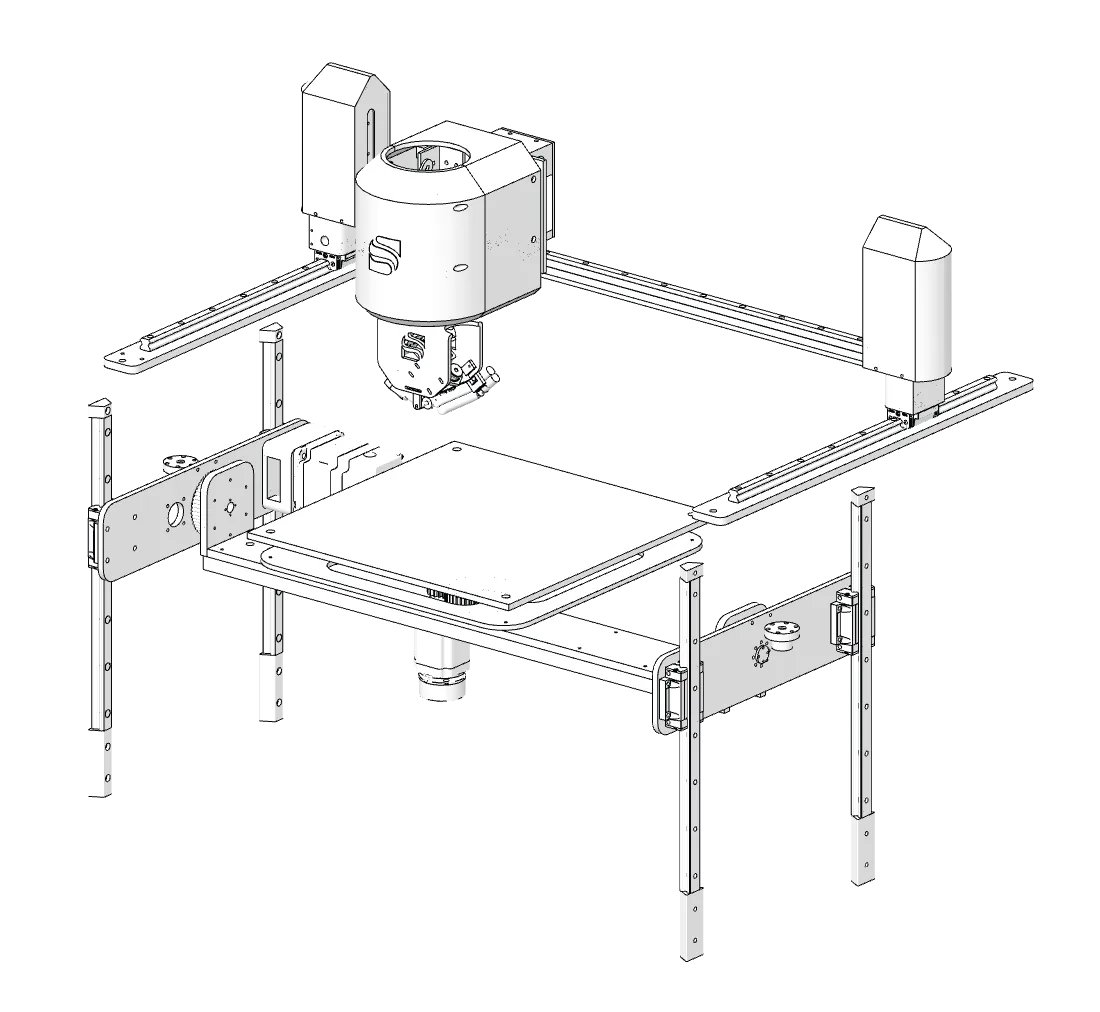
Automated composite manufacturing on 6 axes
Three translations and three rotations, on a tilting table or a rotary mandrel. The part stays as you designed it, without being simplified for the machine. Automated deposition reaches where conventional AFP stops: small and medium parts with tight radii and closed geometries, which would otherwise be laid up by hand.
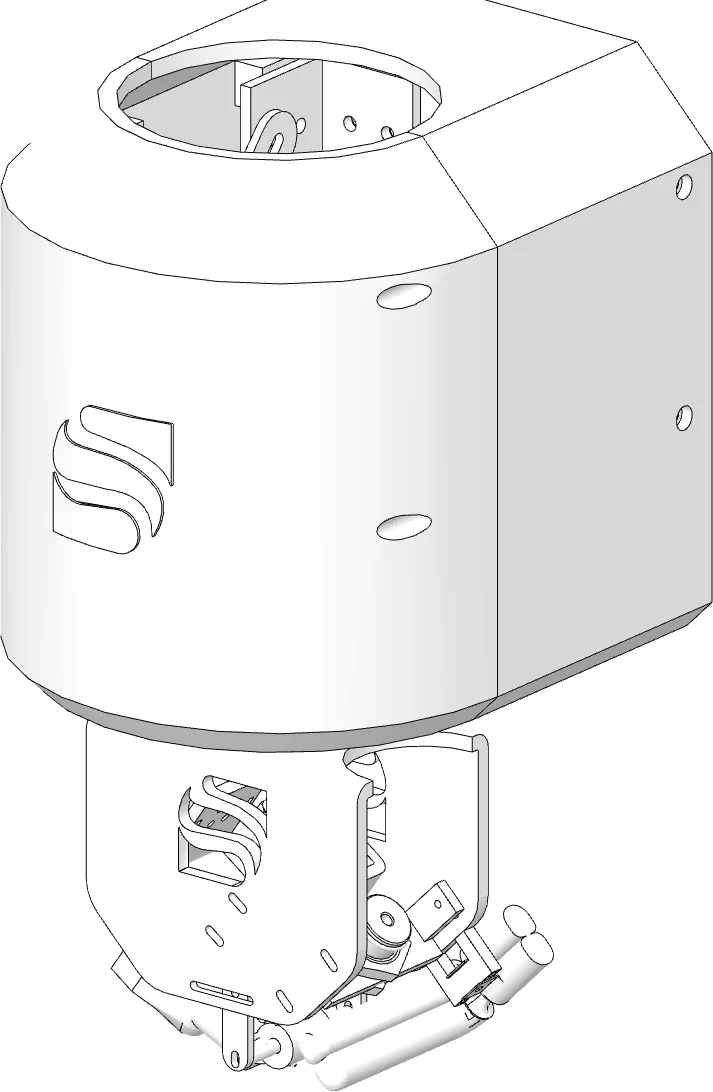
Deposition head
A single head lays the LOOM towpreg and steers it through curves without changing width or thickness.
Paths driven by LACE
Fibre follows the loads: constant-width curves, 0°, 90° and ±θ, interruptions only where needed.
Technical specifications

| Axes | 4 standard, up to 6 · tilting table or rotary mandrel |
|---|---|
| Working volume | 400 × 400 × 350 mm |
| Fibre positioning | ±0.2 mm |
| Material | LOOM towpreg, impregnated in-house by Spherecube |
| Fibres | Carbon, glass, quartz, aramid, flax, hemp |
| Resins | Thermosets: epoxies, bio-based, flame-retardant high-Tg, with excellent electromagnetic transparency · structural thermoplastics in development |
| Curing | Press (fast cure), autoclave or oven under pressure |
| Footprint · weight | 100 × 100 × 185 cm · 250 kg |
| Power | 230 V · IEC 320 C14 |
| Connectivity | USB-C, remote control |
| Software | LACE · STL, 3MF |
| Patent | Granted in Italy, extension to EU and US |
Where LOOP fits
Every process has its field. When does LOOP make more sense than hand lay-up, traditional AFP or filament winding? When the part is structural and geometrically complex and continuous fibre is needed only where it carries load. Compared with an automated fibre placement machine built for large surfaces, LOOP offers production-grade repeatability on small and medium parts.
| Hand lay-up | Traditional AFP | Filament winding | LOOP | |
|---|---|---|---|---|
| Parts | Any | Large (wings, fuselages) | Tubes, vessels | Small–medium, complex |
| Fibre angles | Operator-dependent | With minimum steering radius | Helical / hoop only | 0°, 90°, ±θ, steered |
| Fibre interruption | Manual | Yes | No | Yes, only where needed |
| Repeatability | Low | High | High | High |
| Scrap | High | Low | Low | Low |
| Cell investment | Low | Very high | Medium | Modest |
Early access for research teams
The first release of LOOP is an open machine for teams who want to experiment with automated deposition and build in-house know-how. Process parameters, deposition paths and materials all stay accessible. In the long term, the offer is the complete platform in your own facility: LOOP, LACE and the materials that suit you.
 Open parametersSpeeds, temperatures, compaction.
 Editable pathsFrom the LACE program to the single path.
 Your materialsFibres and resins to qualify with LOOM.
 By your sideOur process engineers.
Bring us a difficult part
From drawing to production, in four steps.
 01AnalysisLoads, constraints, volumes. Feasibility in 10 days.
 02RedesignFibre along the loads, in LACE.
 03ValidationPrototype and tests on the real part.
 04High rateThe same part, every time.