 Loop
 Lace
 Materials
Carbon fibre bracket: from metal to composite
Updated 15 October 2026
A structural bracket for aerospace and defence, machined from solid 7075 aluminium, redesigned and produced in continuous carbon fibre with the Spherecube system: LACE for the fibre paths, LOOP for automated deposition on up to 6 axes.
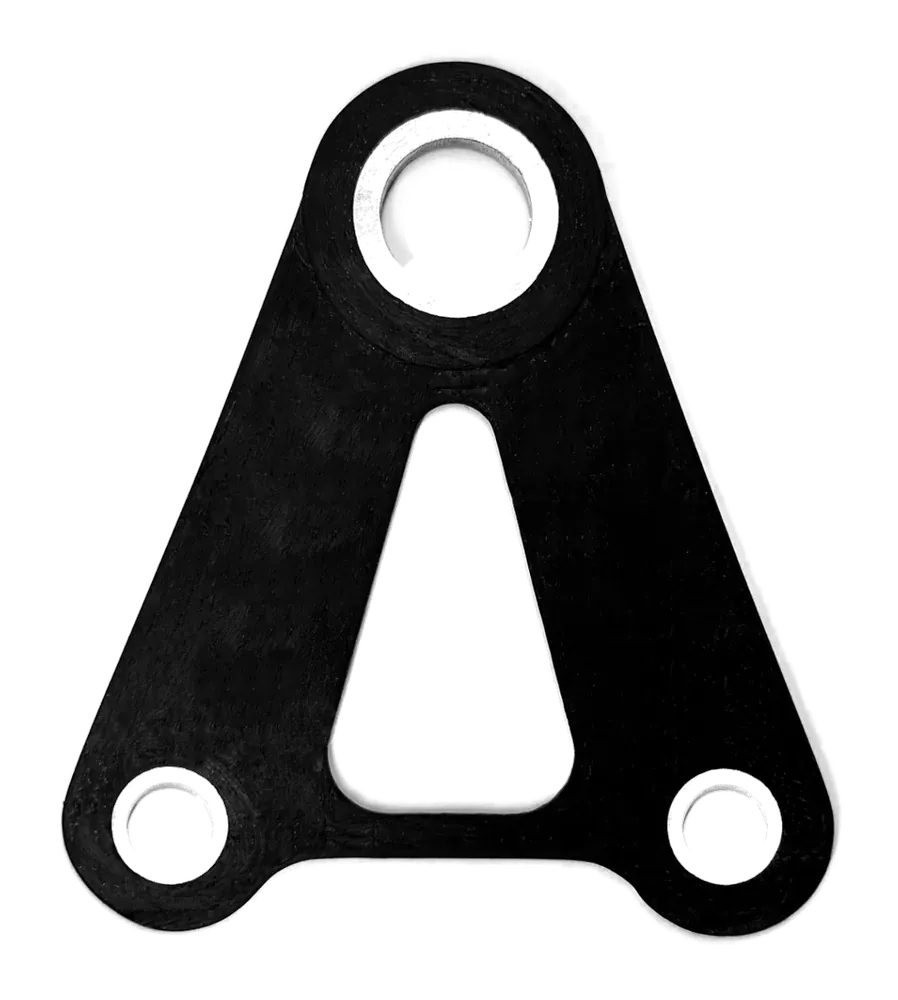
7075 aluminium machined from solid vs carbon/epoxy with LOOP
| 7075 aluminium machined from solid | Carbon/epoxy with LOOP | |
|---|---|---|
| Weight | reference | −92% |
| Cost | reference | −50% |
| Material waste | reference | −99% |
| Full cycle | 125 h | 51 h |
| Fibre placement | — | ±0.2 mm |
The full cycle covers design, programming, production and curing, from file to finished part.
Challenge
The starting component was a 7075 aluminium bracket milled from solid. It is the usual route for a part of this kind, but it has three limits. The first is material: to obtain the finished bracket you buy a block much larger than the part, and almost all of it becomes swarf. The second is weight, because the metal is present even where the loads do not require it. The third is time: every design revision means reprogramming the machining and remaking the part. The aim was to replace aluminium with a carbon/epoxy composite, keeping the metal fastening points and the performance required by the design, while reducing weight, cost and waste.
Redesigning around loads, not shape
We did not copy the geometry of the metal part. We started from the loads and the attachment points and redesigned the bracket as a composite part. In LACE, our CAD/CAM software, the 3D model becomes a set of fibre paths: the continuous fibre is oriented along the directions in which the part works, so material is concentrated where it is needed and absent where it is not. LACE lets you compare several variants of the same part before producing it and generates the program for LOOP directly.
Production with LOOP
LOOP deposits towpreg, that is carbon fibre pre-impregnated with epoxy resin in our LOOM system, on up to 6 axes with fibre placement of ±0.2 mm. Three metal bushings are integrated into the laminate during deposition and co-cured with the part: they are not bonded afterwards, but are part of the structure from the start. After deposition the part is compacted and cured. The process is automated and repeatable: the same file produces the same part.
Results
Compared with the 7075 aluminium bracket machined from solid, the carbon/epoxy version made with LOOP weighs 92% less and costs 50% less. Material waste is reduced by 99%, because the fibre is deposited only where it is needed instead of being removed from a block. The full cycle goes from 125 to 51 hours: it covers design, programming, production and curing, from file to finished part.
What it means for aerospace and defence
Less mass means more range or more payload. An automated, repeatable process is the basis for component qualification, which manual lay-up struggles to guarantee. And because the part starts from a file, it can be stored in a digital catalogue and produced when needed, even years later: this is the principle of the virtual warehouse, which reduces stock and downtime.
Confidentiality note
Customer, loads and detailed geometry are covered by confidentiality agreements. To find out more about the comparison method, contact us.
Frequently asked questions
Can metal inserts be integrated into a carbon fibre part?
Yes. Bushings and inserts are positioned during deposition and co-cured with the laminate, so they are part of the structure instead of being bonded at a later stage.
Can carbon fibre replace aluminium in my part?
Often yes, but it depends on loads, constraints and operating environment. The quickest way to find out is a feasibility study: send us the drawing and within 10 working days we will tell you whether and how it pays off.
Does this process only work for aerospace?
No. The same approach applies to motorsport, automotive, robotics, sport and biomedical, wherever a lightweight, repeatable structural part is needed.